Hardware Experiments
Patent notice: The underlying methods are covered by pending patent applications.
TSVF Algorithm Experiments (IBM Quantum, Feb–Mar 2026)
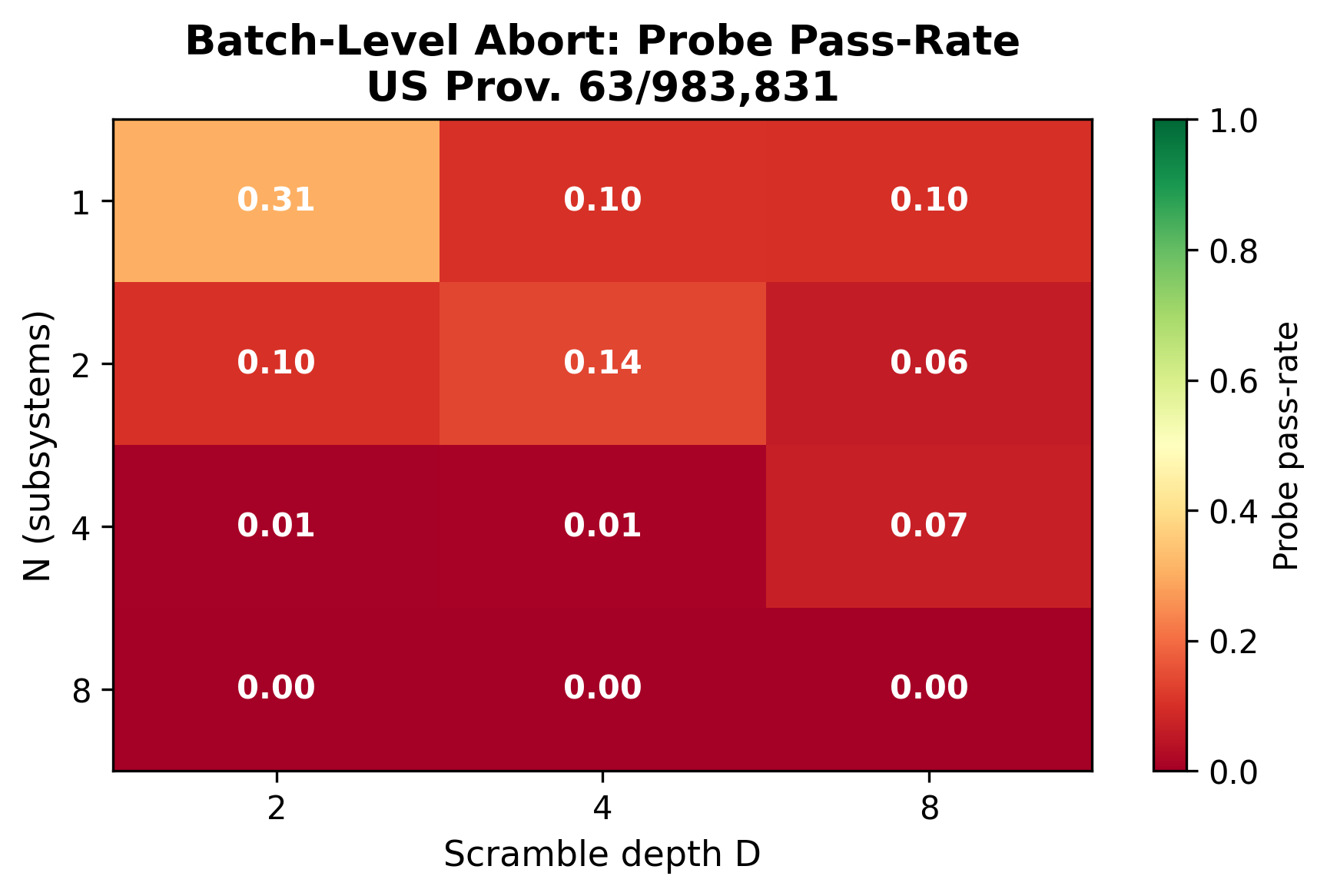
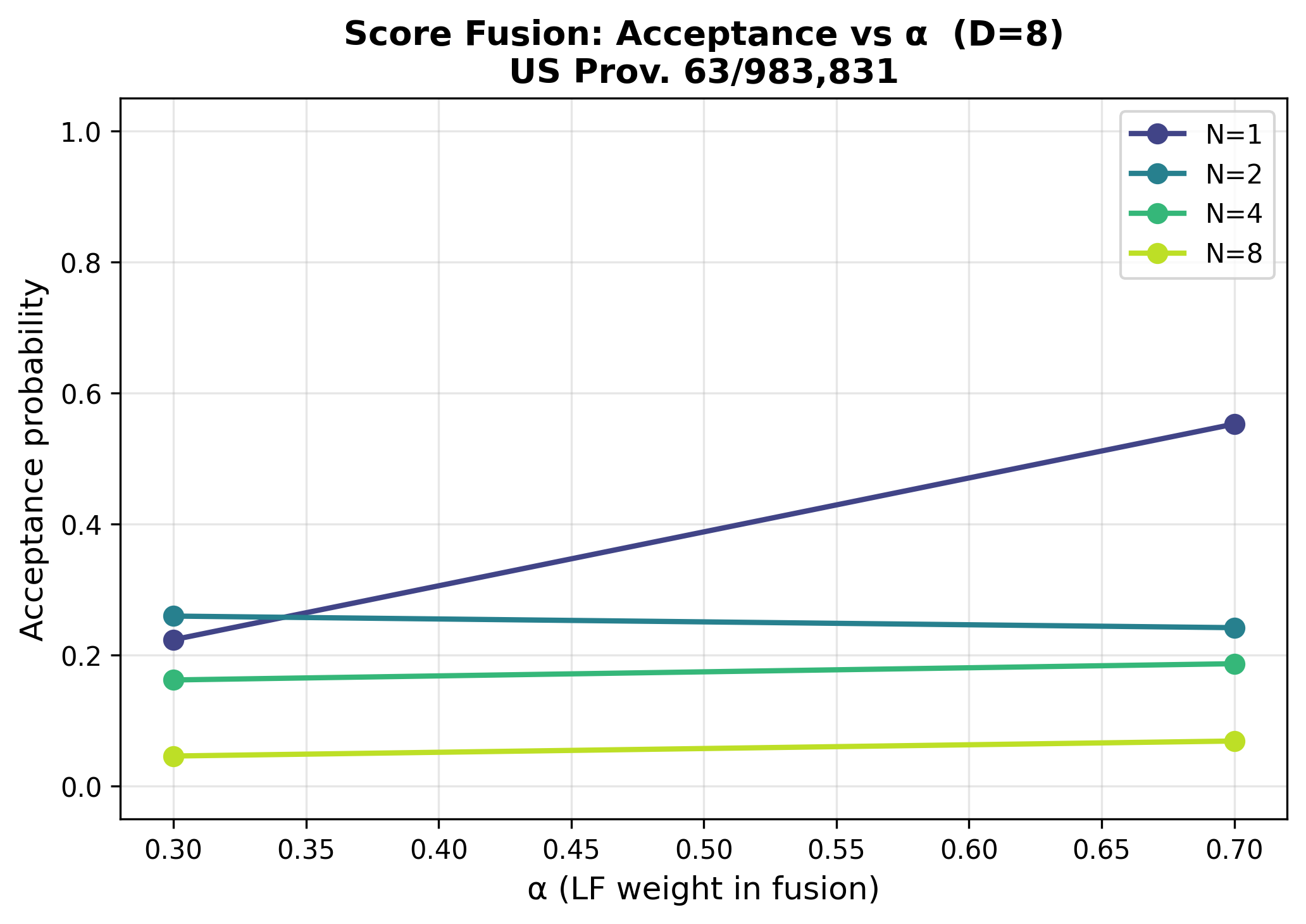
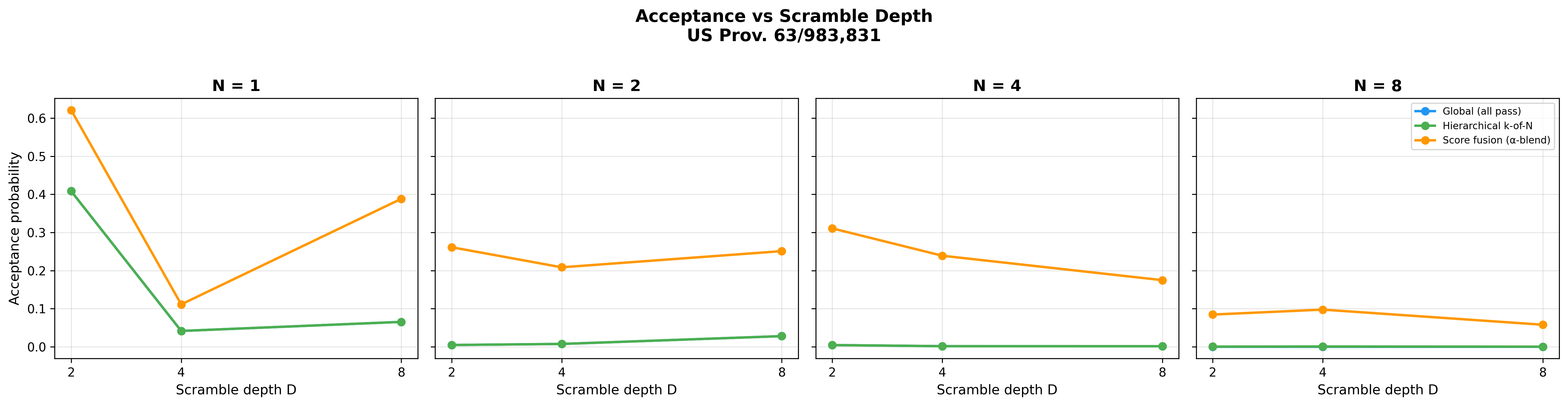
These experiments extend qgate's trajectory filtering beyond Bell-pair conditioning to four canonical quantum algorithms. The TSVF (Two-State Vector Formalism) approach injects a mild chaotic perturbation and uses an ancilla-based probe to create a post-selectable quality signal — then filters for high-fidelity execution trajectories.
Methodology
Standard Algorithm:  H → Algorithm Gates → Measure
                          ↓
TSVF Variant:       H → Algorithm Gates → Chaotic Perturbation → Probe Ancilla → Measure
                                                                        ↓
                                                              Post-select on ancilla |1⟩
The chaotic perturbation is deliberately mild — small random rotations scaled as \(\pi / (c \cdot \sqrt{d})\) where \(d\) is the circuit depth parameter. The probe ancilla applies controlled rotations that reward bitstrings consistent with the expected solution structure. Post-selection on the ancilla measuring \(|1\rangle\) retains only trajectories that survived both the hardware noise and the perturbation.
Results Summary
| Algorithm | Backend | Metric | Standard | TSVF | Advantage |
|---|---|---|---|---|---|
| Grover (iter=4) | IBM Fez | Success probability | 0.0830 | 0.6105 | 7.3× |
| QAOA (p=1) | IBM Torino | Approximation ratio | 0.4268 | 0.8029 | 1.88× |
| VQE (L=3) | IBM Fez | Energy gap to ground | 2.398 | 1.291 | 1.86× closer |
| QPE (t=7) | IBM Fez | Phase fidelity | 0.1569 | 0.0076 | N/A |
| Utility-Scale (133Q) | IBM Torino | Cooling delta | −4.108 | −4.188 | Δ = −0.080 |
Why TSVF Works for Some Algorithms but Not Others
The critical distinction is between amplitude-encoded and phase-coherence-encoded information:
| Property | Grover / QAOA / VQE | QPE |
|---|---|---|
| Answer encoding | Amplitude pattern in computational basis | Phase coherence across precision register |
| Perturbation effect | Slightly scrambles amplitudes | Destroys inverse QFT interference |
| Post-selection recovers? | Yes — filters trajectories where signal survives | No — destroyed phase info is unrecoverable |
| Depth sensitivity | Moderate — noise accumulates gradually | High — single perturbation collapses peak |
Amplitude-encoded algorithms (Grover, QAOA, VQE)
The answer is spread across computational basis state amplitudes. A mild perturbation slightly degrades these amplitudes, but the probe ancilla can detect which trajectories retained the signal. Post-selection filters out noise-corrupted paths, yielding a smaller but higher-fidelity sample.
Phase-coherence algorithms (QPE)
The answer is encoded in the relative phases between precision qubits, which the inverse QFT converts to a sharp probability peak. Any perturbation disrupts this phase coherence, and the inverse QFT produces a diffuse rather than peaked distribution. Post-selection cannot reconstruct the destroyed phase information.
Reproduction
All experiments can be reproduced with a .secrets.json file containing
your IBM Quantum token:
See each experiment page for specific commands.
Statistical Validation: Bias Study (Mar 2026)
Beyond the real-hardware TSVF experiments above, we conducted a rigorous 4-part statistical validation of qgate's Galton trajectory filter under controlled, reproducible conditions — 15 independent trials × 100,000 shots with an IBM Heron-class noise model.
| Experiment | Key Finding | Significance |
|---|---|---|
| Noise Robustness | MSE reduction grows from 13.6% → 20.7% as noise increases | All \(p < 10^{-23}\) |
| Qubit Scaling | Stable 14–17% MSE reduction; variance collapse up to 5,360× | All \(p < 10^{-46}\) |
| Cross-Algorithm | Algorithm-agnostic: VQE +14.8%, QAOA +48.8%, Grover +24.4% | All \(p < 10^{-17}\) |
| Train/Test Split | Frozen threshold generalises: 14.7% MSE↓ on blind test set | \(p = 0.001\) *** |
The Anti-Decoherence Property
Unlike most error mitigation techniques that degrade under heavy noise, qgate's filter improves with noise — the noisier the environment, the better the filter discriminates between the coherent subset and the thermalized bulk.
NEW: Calibrate Once, Deploy Forever
Experiment 4 proves the Galton threshold is a stable physical constant for a given circuit depth and noise environment. Run a cheap calibration circuit to find θ, freeze it, and apply it to massive production runs — with full filtering benefit and zero adaptive overhead.
Full bias study results, methodology, and reproduction steps →
Further Reading
- Architecture & Methodology — mathematical foundations of TSVF conditioning
- How It Works — conceptual overview of trajectory filtering
- Score Fusion — alpha-blended multi-channel scoring
- Dynamic Thresholding — Galton adaptive threshold mechanism
- API Reference — full Python API documentation