QPE vs TSVF-QPE Phase Estimation (IBM Fez)
Patent notice: The underlying methods are covered by pending patent applications.
Objective
Test whether TSVF trajectory filtering can "anchor" the phase estimate in Quantum Phase Estimation, keeping a sharp probability spike on the correct phase binary fraction despite hardware noise as precision qubits increase.
Setup
| Parameter | Value |
|---|---|
| Backend | IBM Fez (156 qubits) |
| Algorithm | QPE for \(U = R_z(2\pi\phi)\) with eigenphase \(\phi = 1/3\) |
| Precision qubits | t = 3–7 |
| Total qubits | t + 1 (eigenstate) + 1 (ancilla) = 5–9 |
| Shots | 8,192 per configuration |
| TSVF variant | Mild perturbation + phase probe ancilla |
| Date | March 2026 |
Why φ = 1/3?
The eigenphase \(\phi = 1/3 = 0.\overline{01}\) in binary is irrational — it cannot be exactly represented in any finite binary fraction. This makes it a good stress test: even a perfect QPE circuit will have inherent approximation error that shrinks as \(2^{-t}\), and hardware noise compounds on top of that.
TSVF Approach
- Standard QPE: Hadamard on precision register → controlled-\(U^{2^k}\) kicks → inverse QFT → measure precision qubits
- TSVF-QPE: Same + mild chaotic perturbation (Rz/Ry with scale \(\pi/(6\sqrt{t})\), sparse CZ ring) + ancilla phase probe (2-controlled-Ry gates rewarding correct binary fraction bits)
- Post-selection: Accept only shots where ancilla measures \(\lvert1\rangle\)
Key Results
| t | Fid(std) | Fid(TSVF) | Err(std) | Err(TSVF) | Ent(std) | Ent(TSVF) | Accept% |
|---|---|---|---|---|---|---|---|
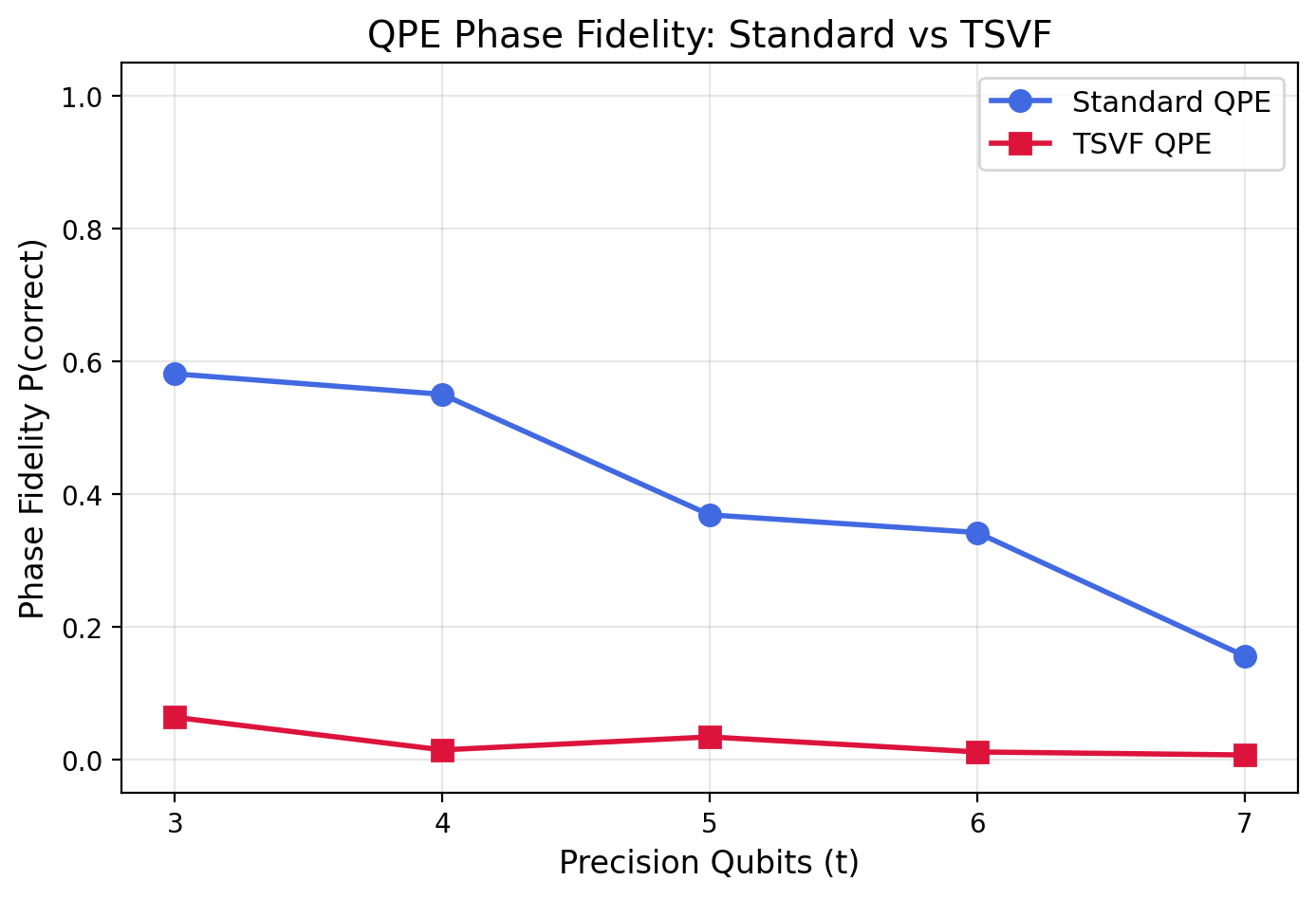
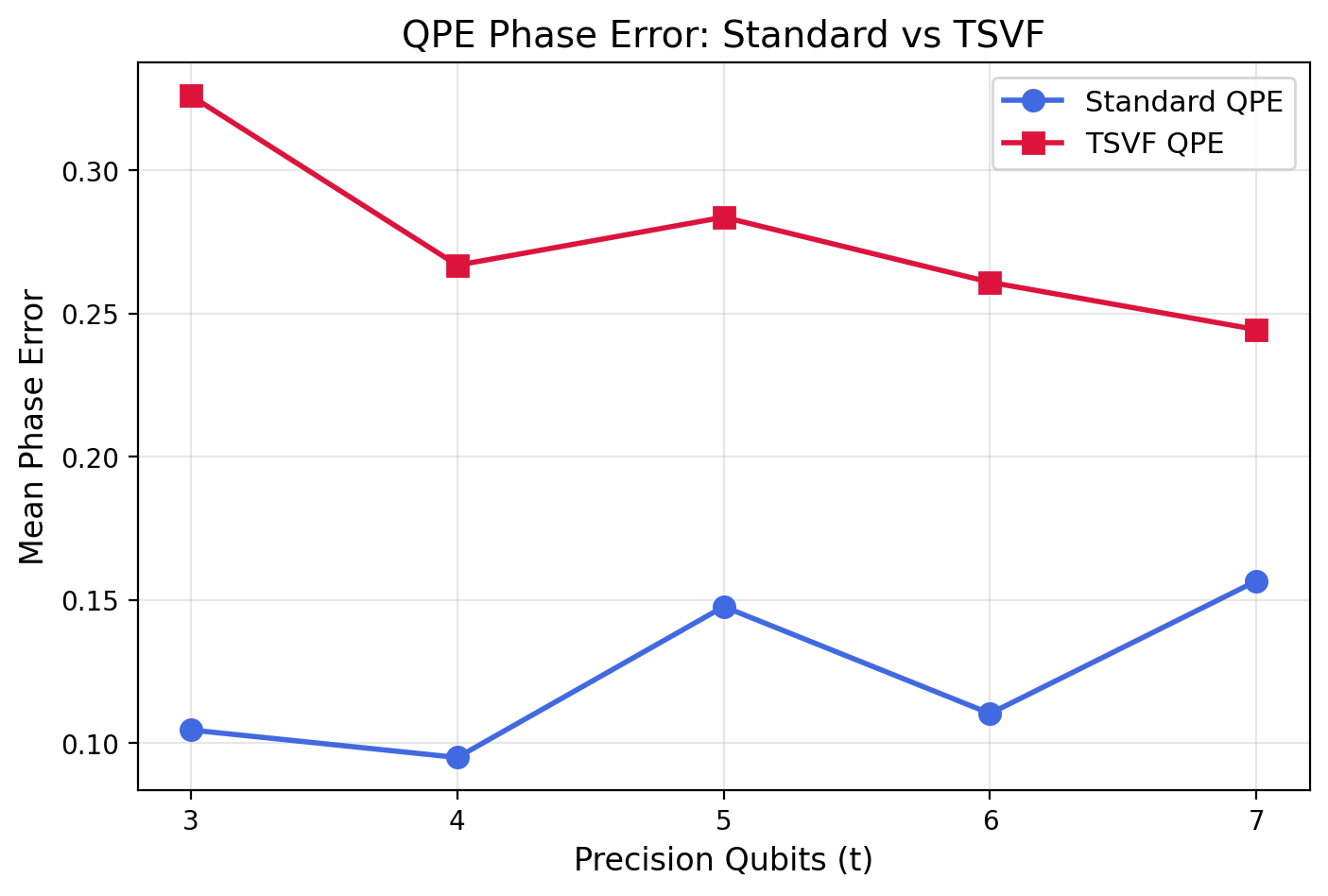
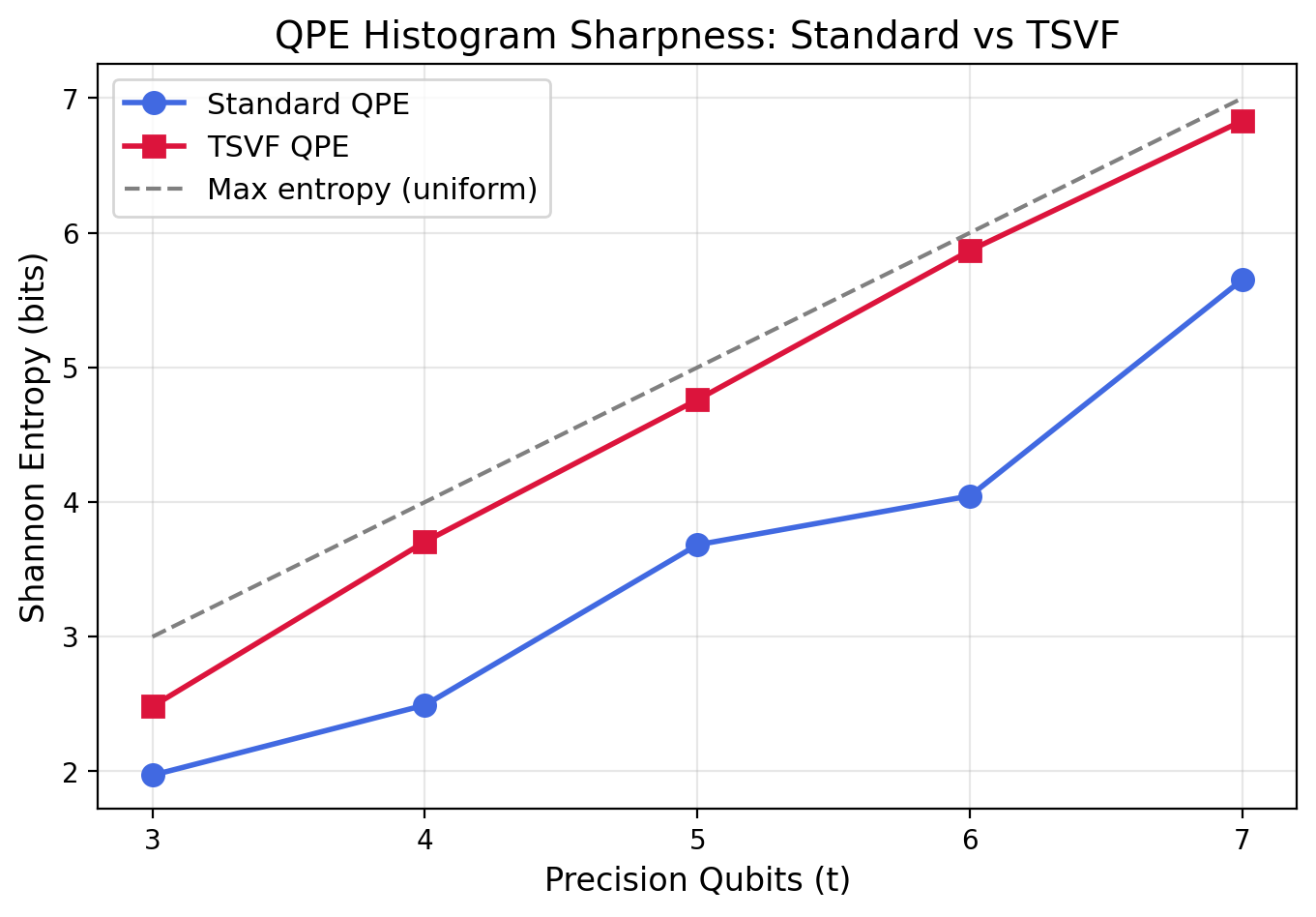
| 3 | 0.582 | 0.064 | 0.105 | 0.326 | 1.97 | 2.48 | 35.8% |
| 4 | 0.551 | 0.015 | 0.095 | 0.267 | 2.49 | 3.71 | 32.0% |
| 5 | 0.369 | 0.035 | 0.148 | 0.284 | 3.68 | 4.76 | 50.5% |
| 6 | 0.343 | 0.012 | 0.110 | 0.261 | 4.05 | 5.87 | 60.1% |
| 7 | 0.157 | 0.008 | 0.157 | 0.245 | 5.65 | 6.83 | 49.6% |
Phase Identification
| t | Correct bits | Std best | ✓ | TSVF best | ✓ |
|---|---|---|---|---|---|
| 3 | 011 |
011 |
110 |
||
| 4 | 0101 |
0101 |
0010 |
||
| 5 | 01011 |
01011 |
11010 |
||
| 6 | 010101 |
010101 |
000010 |
||
| 7 | 0101011 |
0101011 |
0001110 |
Result: TSVF does NOT help QPE
Standard QPE correctly identifies φ ≈ 1/3 at all precision levels on IBM Fez — the hardware is good enough to preserve the phase structure even at depth 411 (t=7). The TSVF perturbation, even at the mild scale of \(\pi/(6\sqrt{t})\), destroys the delicate phase coherence that the inverse QFT relies on, producing near-uniform random output.
Why TSVF Fails for QPE
QPE encodes its answer in the phase coherence of the precision register after the inverse QFT. The controlled-\(U^{2^k}\) gates establish precise phase relationships between qubits, and the inverse QFT converts these into a probability peak at the correct binary fraction.
Any unitary perturbation on the precision register — even small rotations — disrupts these phase relationships. The inverse QFT then produces a diffuse distribution instead of a sharp peak. Post-selection on the ancilla cannot recover the destroyed phase information because it was lost before measurement.
Lesson Learned
TSVF trajectory filtering is effective for amplitude-encoded algorithms but fundamentally incompatible with phase-coherence-encoded algorithms. This is not a failure of the implementation but an intrinsic limitation of the perturbation-based approach.
Reproduction
Requirements
Requires .secrets.json with ibmq_token for IBM hardware runs.
Using the qgate Adapter
from qgate.adapters.qpe_adapter import QPETSVFAdapter
from qgate.config import GateConfig, ConditioningVariant
from qgate.filter import TrajectoryFilter

# Initialize the QPE TSVF adapter
adapter = QPETSVFAdapter(
    backend=backend,          # AerSimulator() or IBM Runtime backend
    algorithm_mode="standard",  # Use "standard" — TSVF is NOT recommended for QPE
    eigenphase=1 / 3,
    seed=42,
)

# Build and run at t=7 precision qubits
circuit = adapter.build_circuit(n_precision=7, n_cycles=1)
raw_results = adapter.run(circuit, shots=8192)

# Parse results
outcomes = adapter.parse_results(raw_results, n_subsystems=8, n_cycles=1)

# Extract best phase estimate
best_bs, best_phase, best_count = adapter.extract_best_phase(
    raw_results, n_precision=7, postselect=False,
)
correct_bits = adapter.get_correct_phase_bits(7)
print(f"Best phase: {best_phase:.6f} (exact: {1/3:.6f})")
print(f"Best bitstring: {best_bs} (correct: {correct_bits})")
TSVF is not recommended for QPE
Use algorithm_mode="standard" for QPE. The TSVF perturbation destroys
phase coherence, which is fundamental to QPE's operation. This is an
intrinsic limitation, not an implementation issue. See
Why TSVF Works for Some Algorithms
for the theoretical explanation.
Related Experiments
- Grover TSVF on IBM Fez — 7.3× improvement for amplitude-encoded search
- QAOA TSVF on IBM Torino — 1.88× improvement for amplitude-encoded optimization
- VQE TSVF on IBM Fez — barren plateau avoidance for amplitude-encoded eigensolving
- All Experiments Overview — amplitude vs phase encoding comparison