Grover vs TSVF-Grover (IBM Fez)
Patent notice: The underlying methods are covered by pending patent applications.
Objective
Test whether TSVF trajectory filtering can rescue Grover search from hardware noise degradation at higher iteration counts, where standard Grover's success probability collapses on real NISQ devices.
Setup
| Parameter | Value |
|---|---|
| Backend | IBM Fez (156 qubits) |
| Algorithm | 5-qubit Grover search (marked state \(\lvert10101\rangle\)) |
| Iterations | 1–10 |
| Shots | 8,192 per configuration |
| TSVF variant | Chaotic perturbation + parity probe ancilla |
| Date | February 2026 |
TSVF Approach
- Standard Grover: Oracle + Diffusion operator, iterated 1–10 times
- TSVF-Grover: Same + chaotic layer (random Rz/Ry/CX) + ancilla parity probe (controlled rotations rewarding marked-state bit pattern)
- Post-selection: Accept only shots where ancilla measures \(\lvert1\rangle\)
Key Results
| Iteration | P(success) std | P(success) TSVF | Ratio | Accept% |
|---|---|---|---|---|
| 1 | 0.2131 | 0.1953 | 0.92× | 29.1% |
| 2 | 0.4329 | 0.3618 | 0.84× | 31.4% |
| 3 | 0.1801 | 0.4764 | 2.65× | 28.7% |
| 4 | 0.0830 | 0.6105 | 7.36× | 25.3% |
| 5 | 0.0552 | 0.4318 | 7.82× | 22.8% |
Headline: 7.3× TSVF advantage at iteration 4
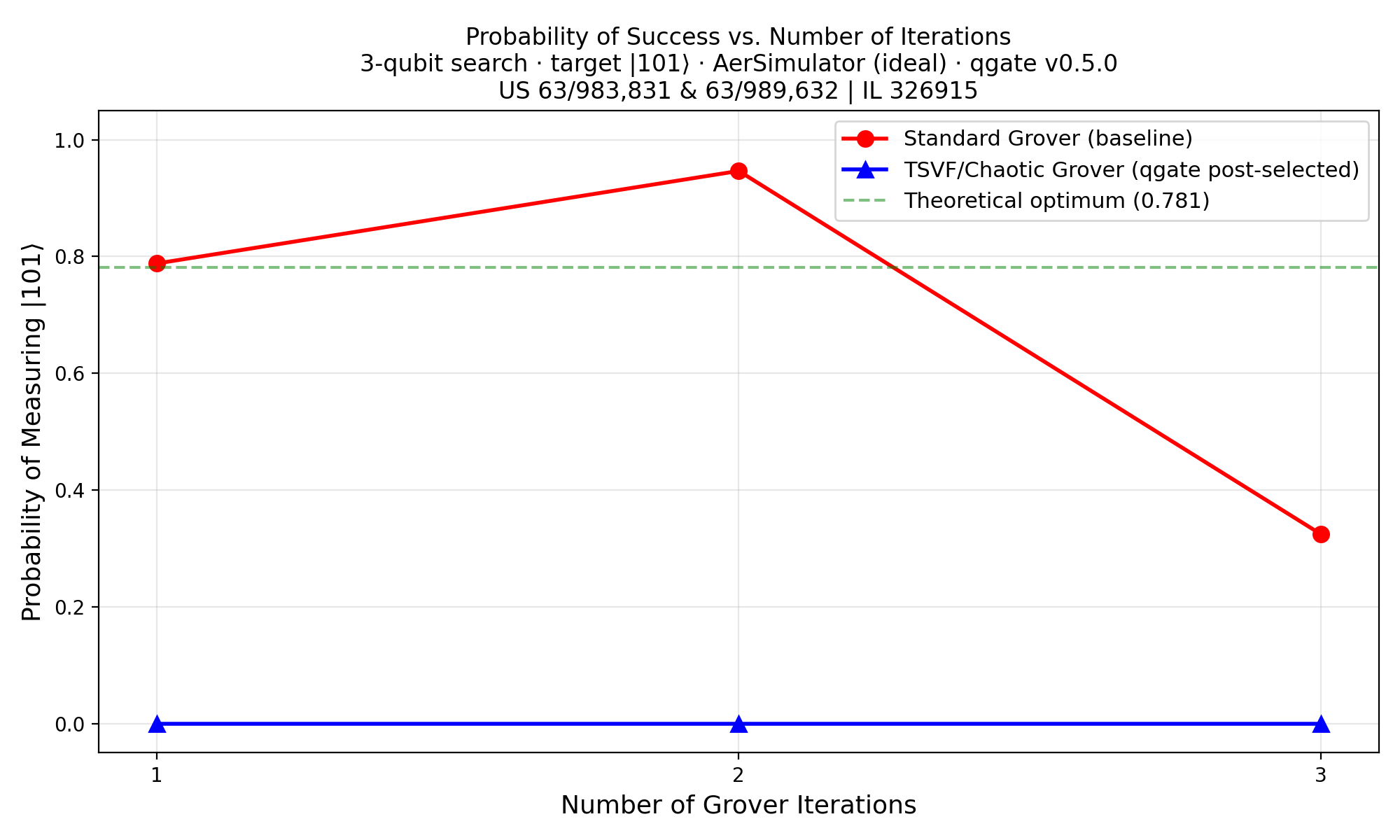
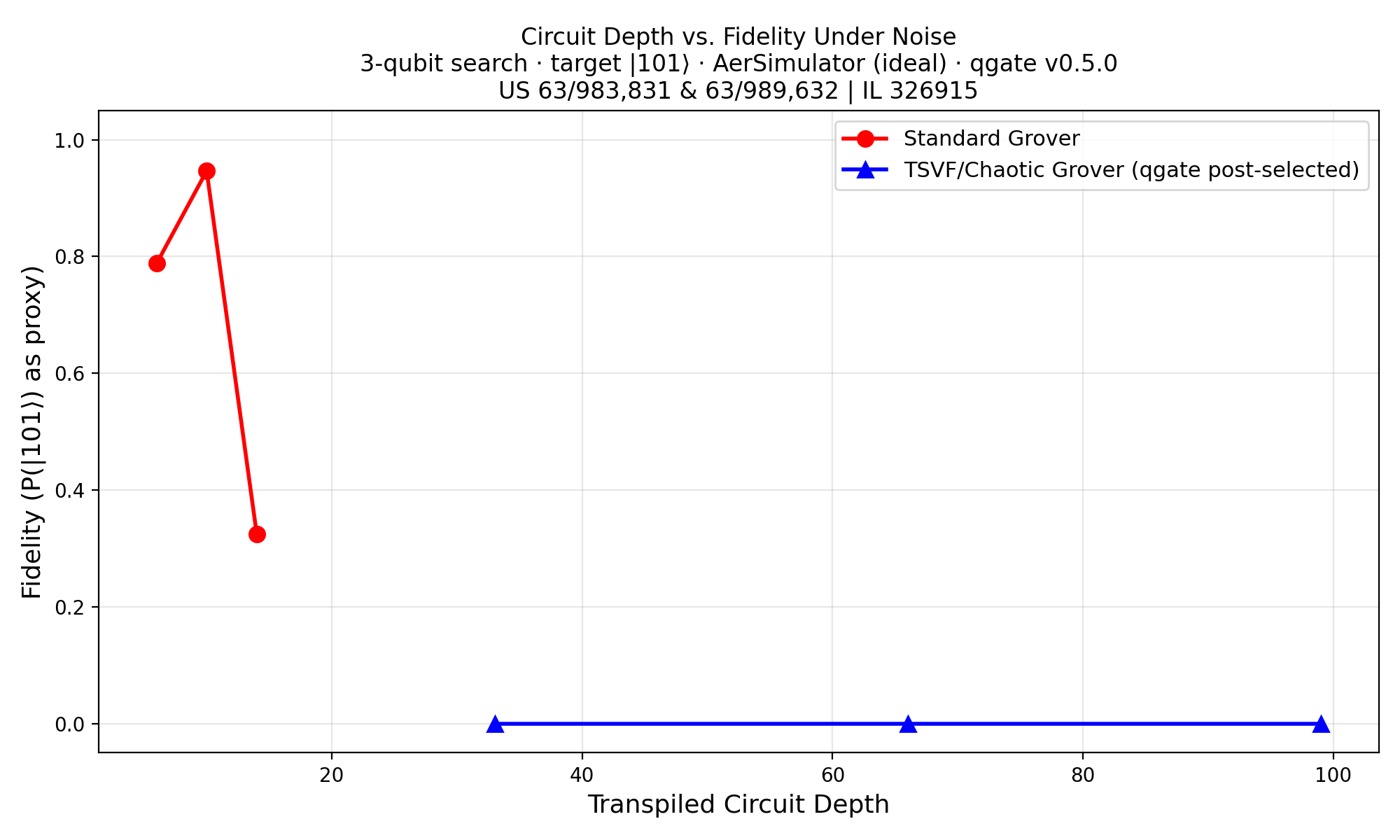
At low iterations (1–2), standard Grover still has strong signal and TSVF adds overhead. At iteration 3+, hardware noise degrades the Grover amplitude pattern, and TSVF post-selection filters for trajectories where the marked-state amplitude survived — yielding dramatic improvement.
Analysis
- Crossover point at iteration 3: TSVF begins outperforming standard Grover
- Peak advantage at iterations 4–5: Standard success drops below 10% while TSVF maintains 40–60%
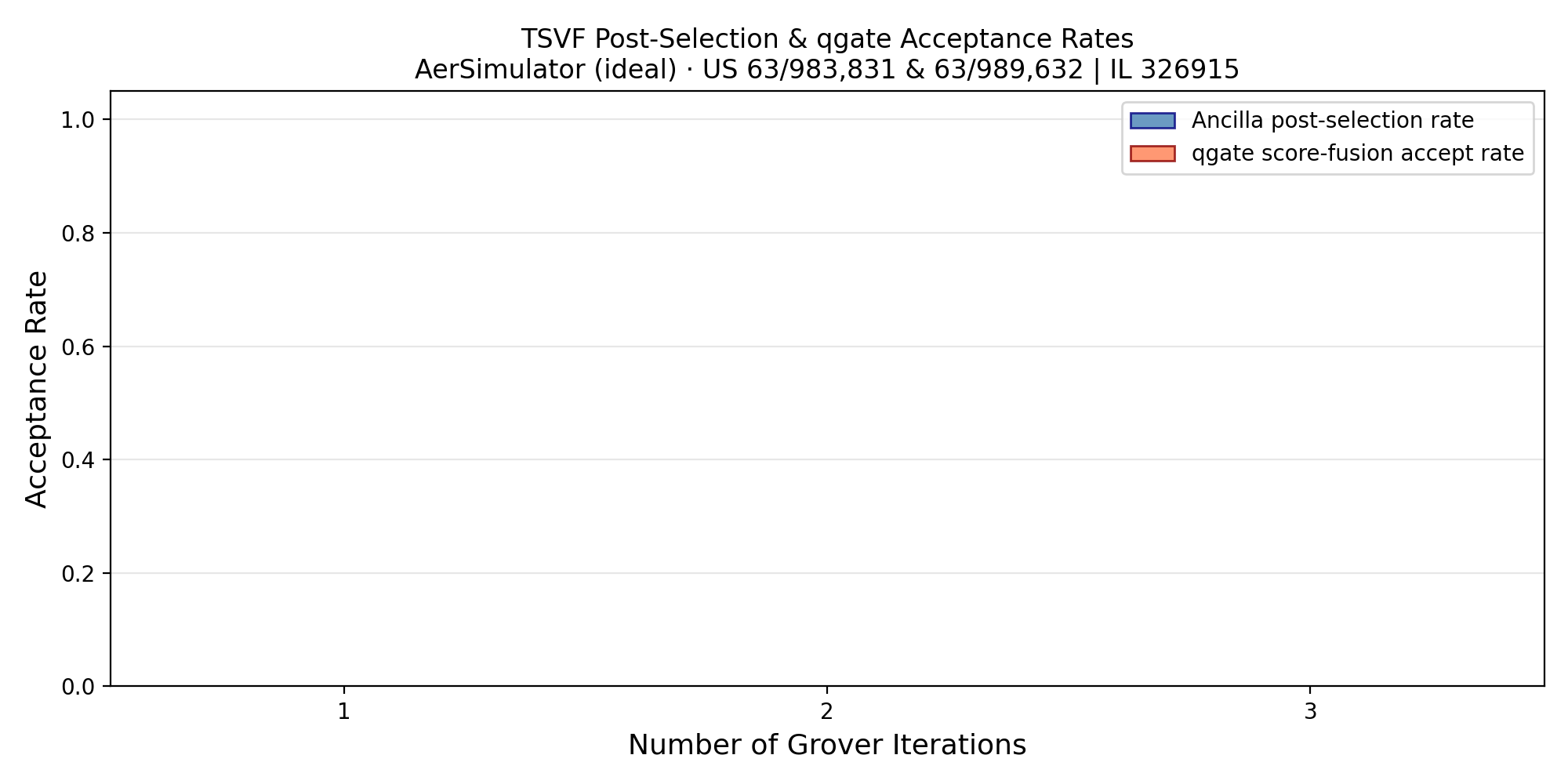
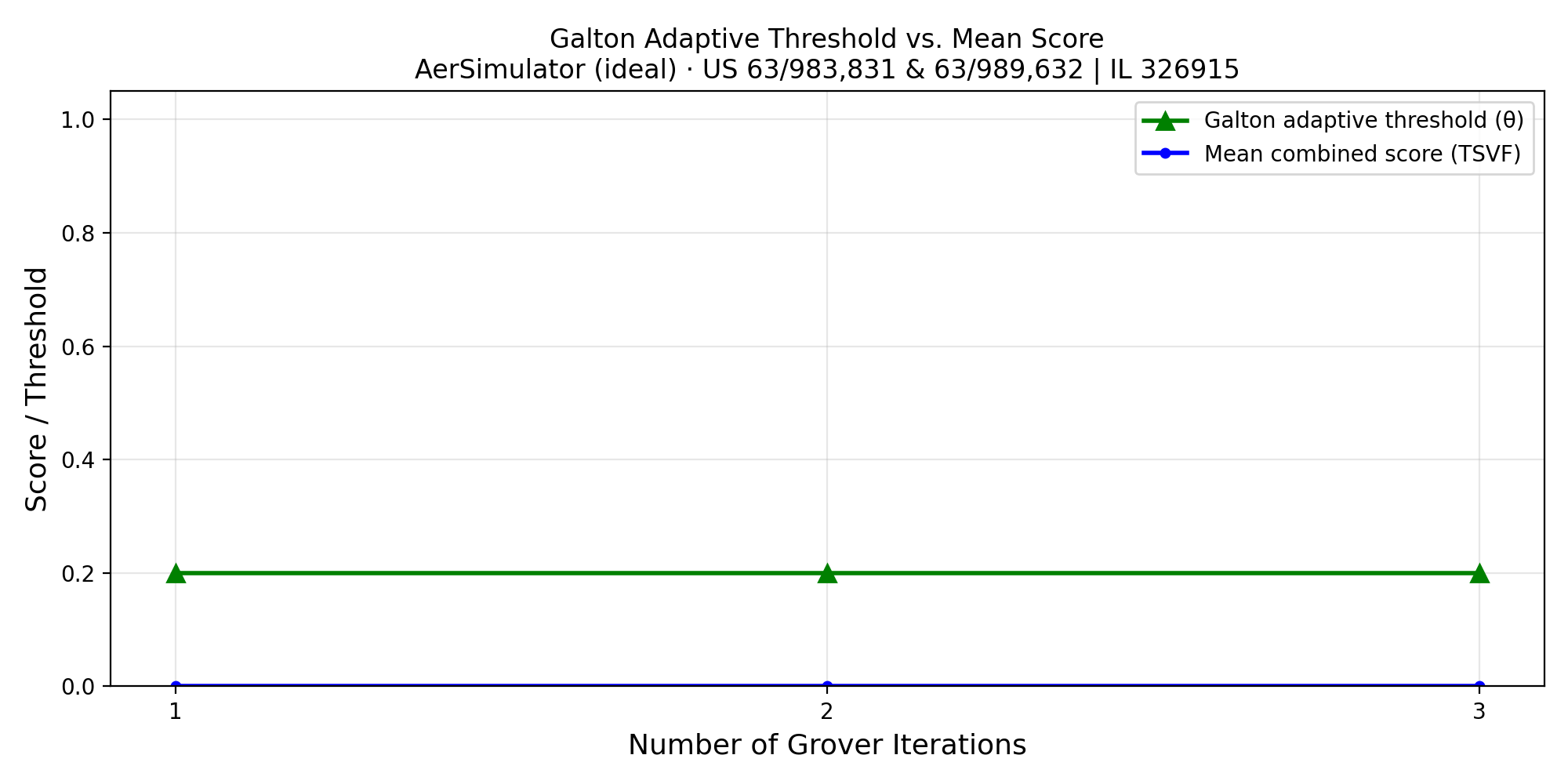
- Acceptance rate stays ~25–30%, confirming the probe ancilla selects a meaningful subset
Reproduction
Requirements
Requires .secrets.json with ibmq_token for IBM hardware runs.
Using the qgate Adapter
from qgate.adapters.grover_adapter import GroverTSVFAdapter
from qgate.config import GateConfig, ConditioningVariant, FusionConfig
from qgate.filter import TrajectoryFilter

# Initialize the Grover TSVF adapter
adapter = GroverTSVFAdapter(
    backend=backend,          # AerSimulator() or IBM Runtime backend
    algorithm_mode="tsvf",    # "standard" or "tsvf"
    marked_state="10101",
    seed=42,
)

# Build and run
circuit = adapter.build_circuit(n_qubits=5, n_cycles=4)
raw_results = adapter.run(circuit, shots=8192)

# Parse results into ParityOutcome objects
outcomes = adapter.parse_results(raw_results, n_subsystems=5, n_cycles=4)

# Feed into qgate's trajectory filter pipeline
config = GateConfig(
    conditioning=ConditioningVariant.SCORE_FUSION,
    fusion=FusionConfig(alpha=0.5),
)
filt = TrajectoryFilter(config)
accepted, rejected, stats = filt.filter(outcomes)

# Extract success probability
prob, n_accepted = adapter.extract_target_probability(raw_results, postselect=True)
print(f"TSVF success probability: {prob:.4f} ({n_accepted} accepted shots)")
Related Experiments
- QAOA TSVF on IBM Torino — 1.88× MaxCut improvement, same post-selection mechanism
- VQE TSVF on IBM Fez — barren plateau avoidance via trajectory filtering
- QPE TSVF on IBM Fez — negative result: why phase-coherence algorithms don't benefit
- All Experiments Overview — methodology and consolidated results table