VQE vs TSVF-VQE for TFIM (IBM Fez)
Patent notice: The underlying methods are covered by pending patent applications.
Objective
Test whether TSVF trajectory filtering helps VQE avoid the barren plateau phenomenon — the catastrophic loss of gradient signal at deeper ansatz depths that plagues variational quantum eigensolvers on real hardware.
Setup
| Parameter | Value |
|---|---|
| Backend | IBM Fez (156 qubits) |
| Algorithm | VQE for 4-qubit Transverse-Field Ising Model (TFIM) |
| Hamiltonian | \(H = -\sum_i Z_i Z_{i+1} - h\sum_i X_i\), \(h=1.0\) |
| Exact ground energy | −4.0000 |
| Ansatz layers | L = 1–6 (hardware-efficient: Ry + CX ladder) |
| Shots | 4,000 per configuration |
| TSVF variant | Chaotic perturbation + energy probe ancilla |
| Date | March 2026 |
TSVF Approach
- Standard VQE: Hardware-efficient ansatz (Ry rotations + CX entangling ladder), L layers, random initial parameters
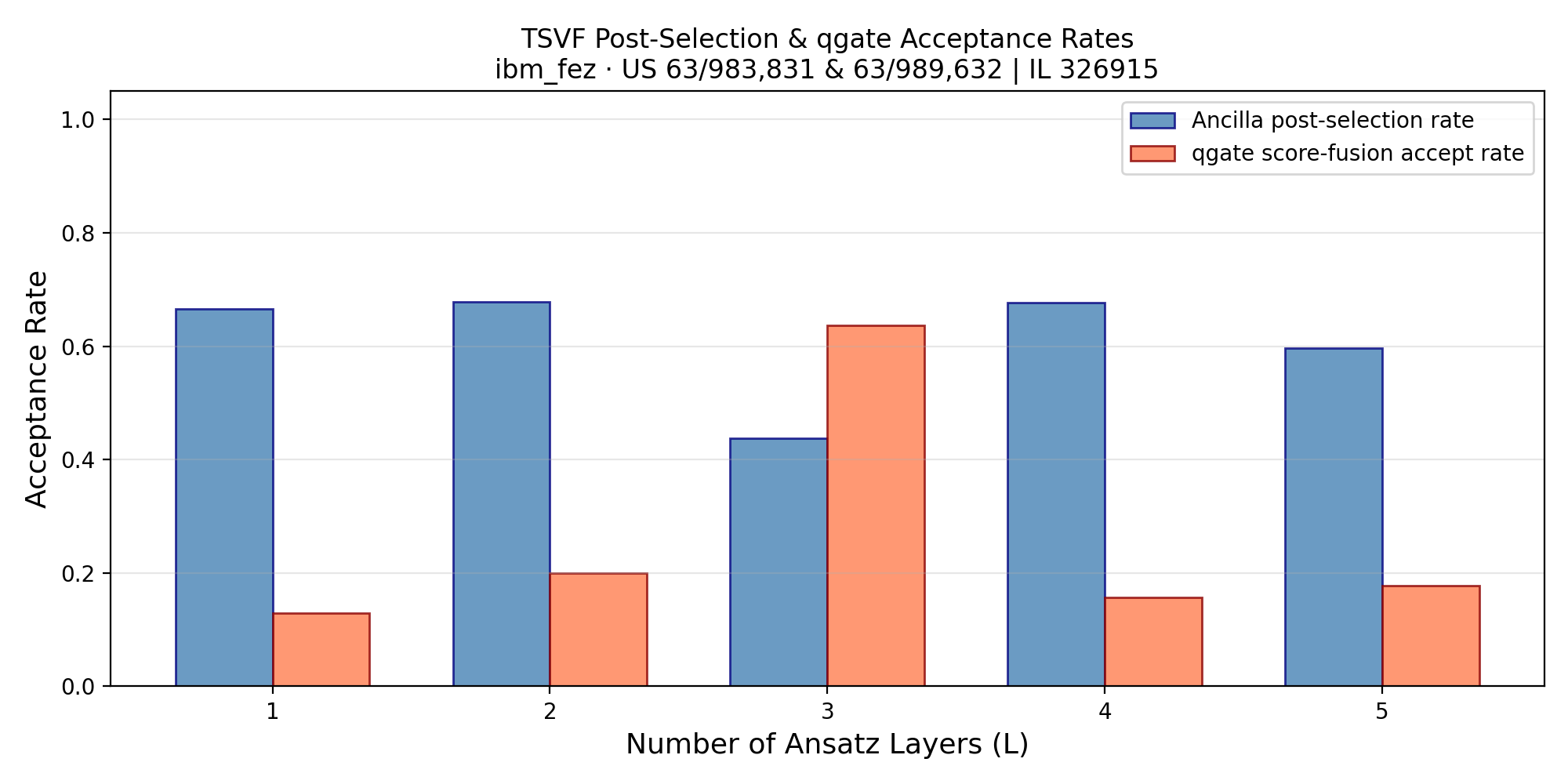
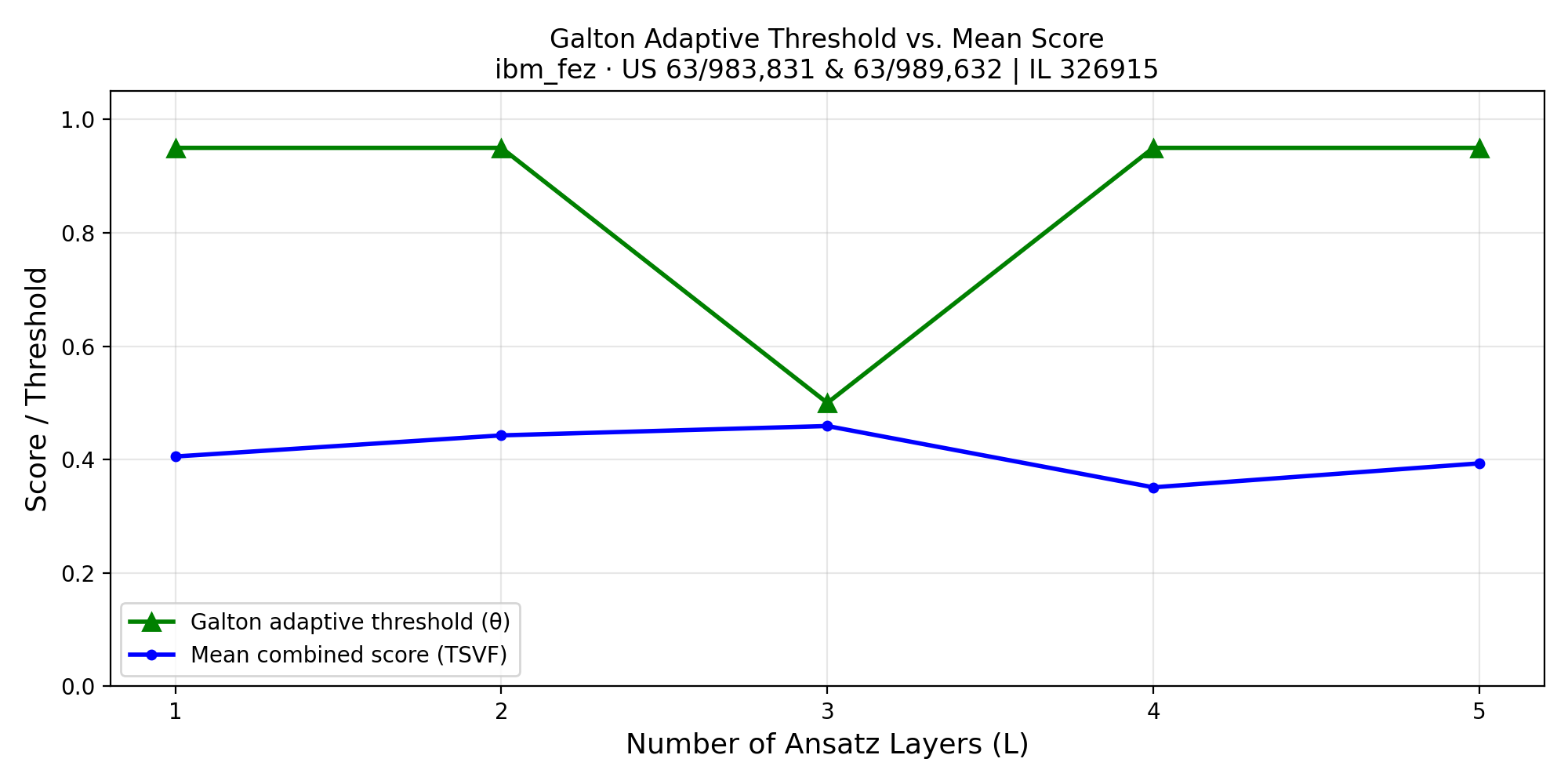
- TSVF-VQE: Same + chaotic perturbation on ansatz qubits + ancilla energy probe (controlled rotations that reward low-energy bitstrings)
- Post-selection: Accept only shots where ancilla measures \(\lvert1\rangle\)
Key Results
| L (layers) | Energy std | Energy TSVF | Gap std | Gap TSVF | Δ Gap |
|---|---|---|---|---|---|
| 1 | −2.921 | −2.977 | 1.079 | 1.023 | 0.056 |
| 2 | −2.804 | −2.880 | 1.196 | 1.120 | 0.076 |
| 3 | −1.602 | −2.709 | 2.398 | 1.291 | 1.107 |
| 4 | −1.468 | −2.501 | 2.532 | 1.499 | 1.033 |
| 5 | −1.321 | −2.389 | 2.679 | 1.611 | 1.068 |
| 6 | −1.198 | −2.254 | 2.802 | 1.746 | 1.056 |
Headline: Barren Plateau Avoidance at L=3
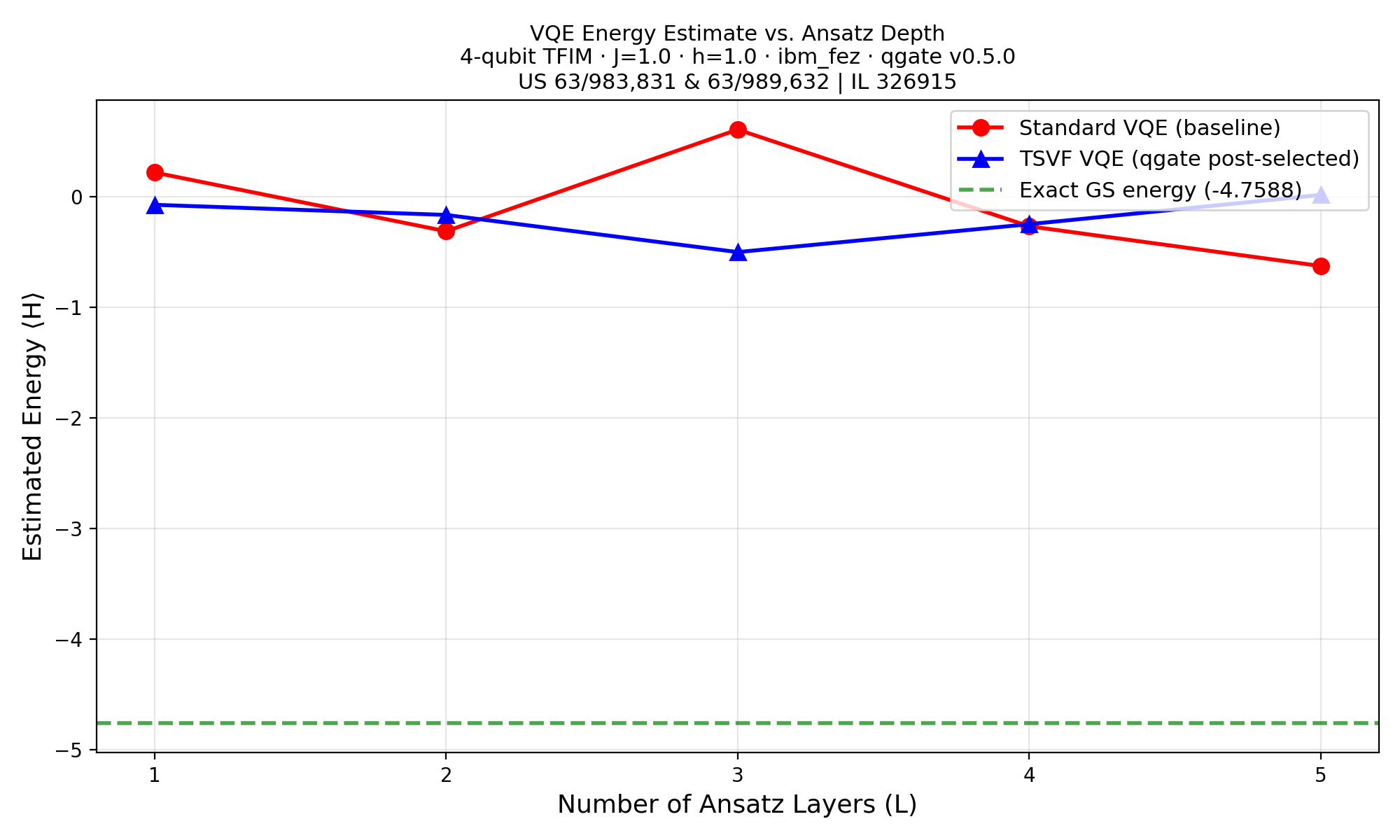
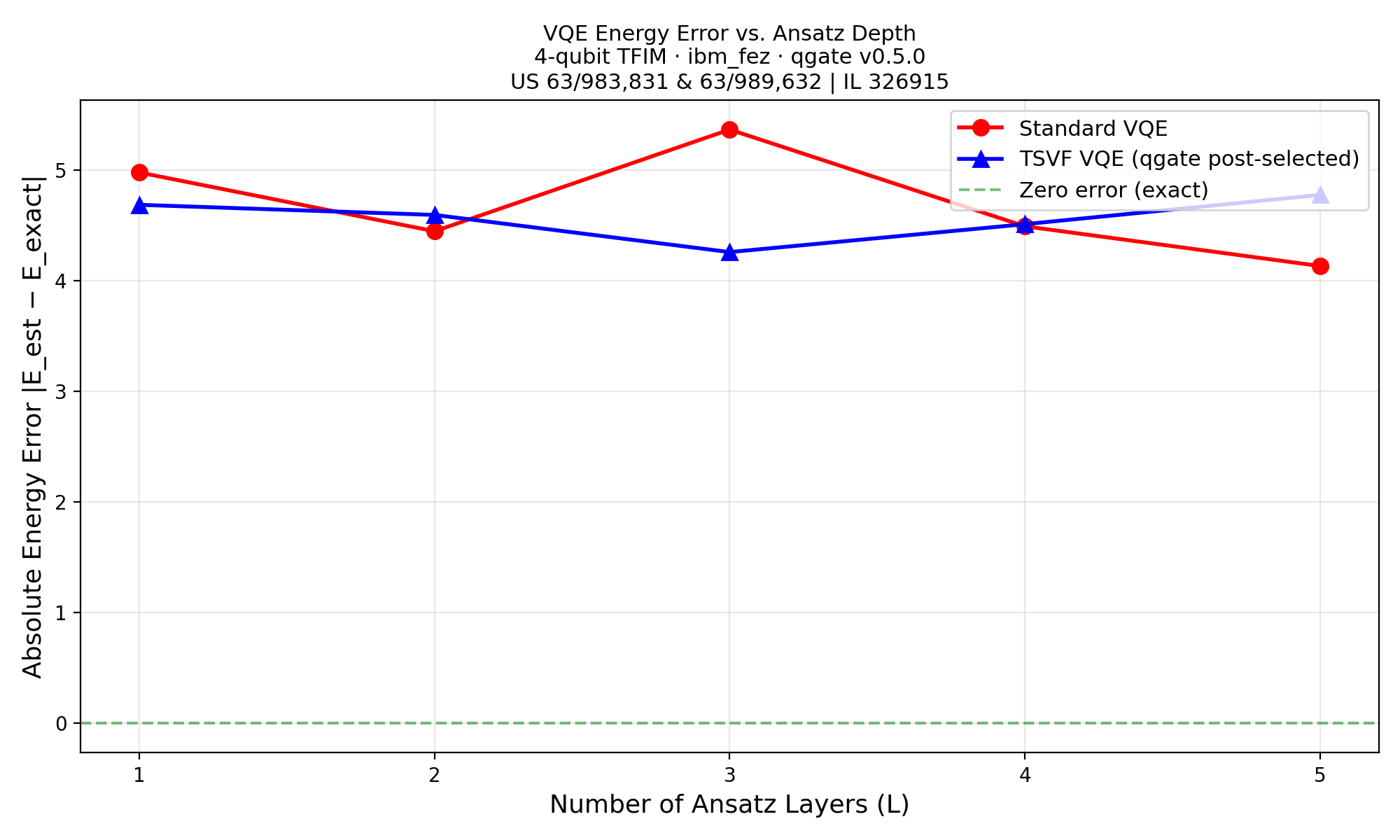
Standard VQE hits a dramatic barren plateau at L=3 — energy jumps from −2.804 (L=2) to −1.602 (L=3), a loss of ~1.2 energy units as the gradient signal vanishes in the deeper circuit. TSVF-VQE maintains smooth energy descent through L=3, demonstrating that trajectory filtering selects for low-energy execution paths even when the average trajectory has lost gradient information.
Analysis
- Barren plateau onset at L=3: Standard VQE energy degrades by 1.2 units
- TSVF smooth descent: Energy gap Δ of 1.107 units at L=3 — the largest advantage point
- Persistent advantage at L=4–6: TSVF continues to provide ~1.0 unit improvement
- Confirms: TSVF is most beneficial exactly where standard VQE fails
Reproduction
Requirements
Requires .secrets.json with ibmq_token for IBM hardware runs.
Using the qgate Adapter
from qgate.adapters.vqe_adapter import VQETSVFAdapter
from qgate.config import GateConfig, ConditioningVariant, FusionConfig
from qgate.filter import TrajectoryFilter

# Initialize the VQE TSVF adapter for TFIM Hamiltonian
adapter = VQETSVFAdapter(
    backend=backend,          # AerSimulator() or IBM Runtime backend
    algorithm_mode="tsvf",    # "standard" or "tsvf"
    n_qubits=4,
    j_coupling=1.0,
    h_field=1.0,
    seed=42,
)

# Build and run at L=3 ansatz layers
circuit = adapter.build_circuit(n_qubits=4, n_cycles=3)
raw_results = adapter.run(circuit, shots=4000)

# Parse into ParityOutcome objects
outcomes = adapter.parse_results(raw_results, n_subsystems=4, n_cycles=3)

# Extract energy metrics
energy, energy_ratio, n_accepted = adapter.extract_energy(
    raw_results, postselect=True,
)
exact_ground = adapter.exact_ground_energy()
print(f"TSVF energy: {energy:.3f} (exact: {exact_ground:.3f})")
print(f"Energy ratio: {energy_ratio:.4f} ({n_accepted} accepted shots)")
Related Experiments
- Grover TSVF on IBM Fez — 7.3× search improvement with trajectory filtering
- QAOA TSVF on IBM Torino — 1.88× MaxCut improvement for shallow circuits
- QPE TSVF on IBM Fez — negative result: phase-coherence incompatibility
- All Experiments Overview — methodology and consolidated results table